
July 7, 2026 · Megan Carter
ICD-10-CM for new coders: how diagnosis coding actually works
CPT codes say what was done. ICD-10-CM codes say why. Every claim needs both halves of that sentence, and the "why" half comes from a code set with tens of thousands of entries, which is exactly why new coders find it intimidating. The good news: the system is more logical than its size suggests. Once you understand how a code is built and how the book wants to be used, most of the fear evaporates.
Anatomy of a code
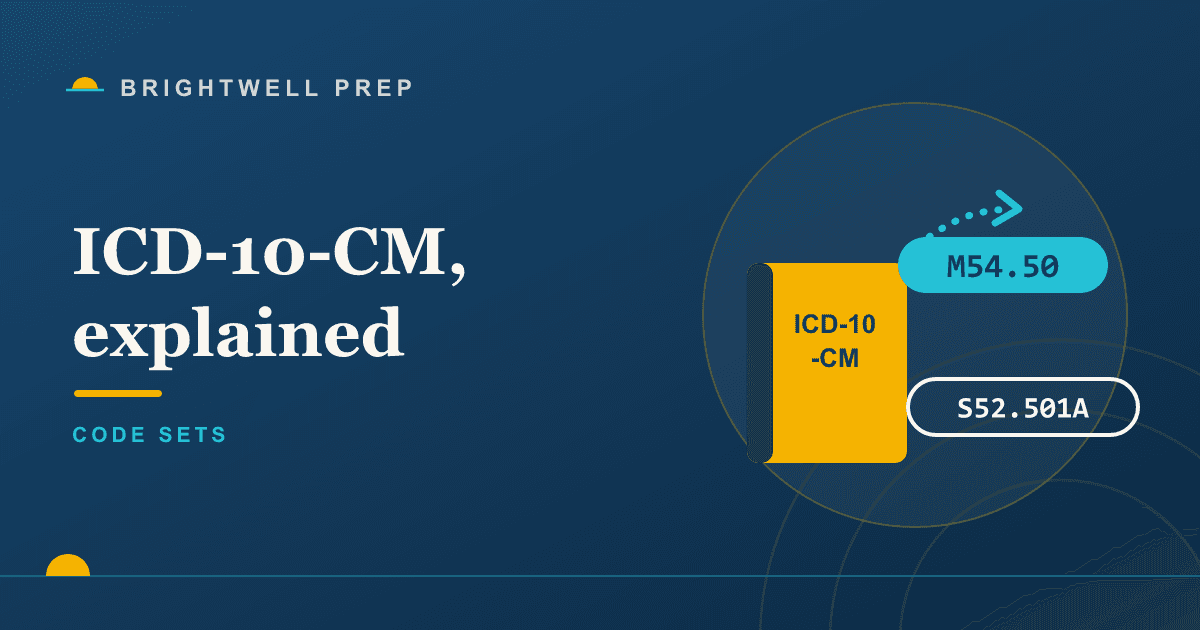
An ICD-10-CM code runs three to seven characters and gets more specific as it grows. Take M54.50, low back pain, unspecified. That first character is always a letter, and it places you in a chapter: M is diseases of the musculoskeletal system. Together, the first three characters (M54) form the category, back pain in general. Everything after the decimal sharpens the picture: which kind, which side, sometimes which encounter.
It's the seventh character that surprises people. For injuries, it tells the claim where you are in the story: A for the initial encounter, D for a follow-up, S for a late effect of an old injury. S52.501A is a fracture of the radius, first time being treated. Same break three months later at a checkup? S52.501D. Miss the seventh character and the claim doesn't just lose detail, it often gets rejected outright.
The two-step lookup you can never skip
Your manual has two halves. You start in the Alphabetic Index, looking up the condition by name. Codes actually live in the Tabular List, organized by chapter, with all the instructions attached.
The rule, and it's the closest thing diagnosis coding has to a commandment: never code straight from the Index. What the Index gives you is a candidate code. Verification happens in the Tabular List, where you discover the things the Index didn't mention, like a required extra digit or a note redirecting you somewhere else entirely. On the CPC exam, the wrong answer choices are frequently the code you'd pick if you stopped at the Index. That's not an accident.
The notes that overrule you
Scattered through the Tabular List are instructional notes, and two of them do the most damage to new coders.
Excludes1 means "these two codes can never appear together, pick one." Excludes2 means "this condition isn't part of that code, but the patient can have both, so code both if both are documented." One word of difference, opposite instructions.
Then there's "code first," which forces an ordering: some conditions must be sequenced after the underlying disease that caused them. All of this is governed by the Official Guidelines, printed at the front of most editions, and they're one of the few things you're allowed to bring into the CPC exam room in printed form. Tab them.
Specificity is the whole game
Payers keep tightening what they accept, and "unspecified" codes are the first thing they push back on. If the note says the fracture is in the left radius, coding it as unspecified side is leaving documented detail on the table. Coding to the highest specificity the documentation supports isn't perfectionism, it's the difference between paid and denied, which I've covered in why claims get denied.
The flip side matters too: you can't code detail that isn't documented. The note is the ceiling. If the provider didn't write it, your job is a query, not a guess.
Fitting it into the bigger picture
ICD-10-CM is one of three books on a coder's desk, alongside CPT and HCPCS Level II. On the CPC exam, diagnosis coding shows up both as its own questions and buried inside case questions, where a wrong ICD-10-CM pick quietly kills an otherwise correct answer.
What makes this automatic is repetition under a clock: Index, Tabular, check the notes, check the guidelines. Our CPC simulator gives you 700 questions' worth of exactly those reps, with the reasoning spelled out for every answer, including the traps.
Written by
Megan CarterMegan Carter writes the Brightwell Prep study guides for allied health certification exams. She writes the way she'd prepare someone for exam day: plain English, real exam-format practice, and a rationale for every single answer. Her guides come with the Brightwell Prep online exam simulator, so readers train under the same time pressure they'll face at the testing center.