
Medical Conversions Without a Calculator: A CCMA Guide
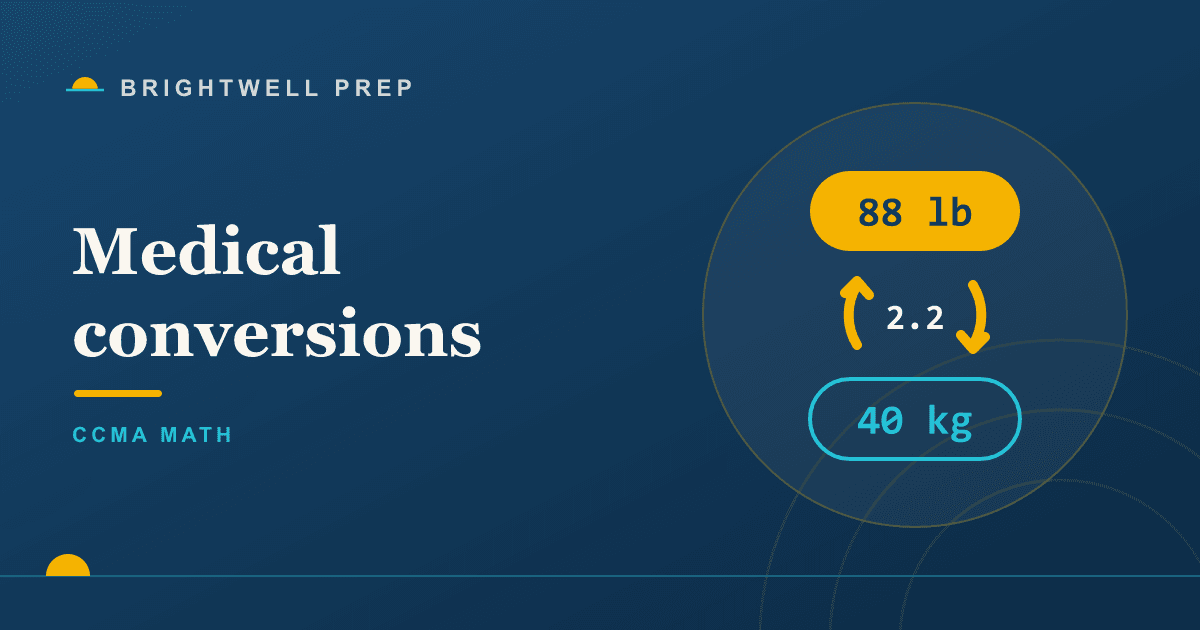
Here's the first thing to clear up, because it changes how you study: you're not actually doing the CCMA without a calculator. NHA's candidate handbook says you may use the built-in, on-screen exam calculator as needed; what you can't do is bring your own or open the one on the testing computer. So the fear behind the search, that you'll be stuck multiplying by hand under a clock, isn't quite right. But that doesn't get you off the hook. The calculator does the arithmetic; it doesn't tell you that a dose ordered in milligrams and stocked in micrograms needs converting, or which way to move the decimal, or that a child's weight came in as pounds when the dosage is per kilogram. That part is on you, and it's the part the exam is really testing.
So the honest goal isn't to compute without a tool. It's to know the conversions cold and set them up correctly, so the built-in calculator does five seconds of math instead of you doing thirty seconds of second-guessing. The rest of this page is the conversions worth having automatic and how to work them fast on a timed test.
Do you actually get a calculator on the CCMA?
Yes, with limits. Per NHA's candidate handbook, telephones, personal computers, tablets, and personal calculators are all prohibited in the exam room, but NHA "allows you to use the built in exam calculator as needed during your exam." You may not use a calculator you brought or the calculator app on the testing workstation, only the one built into the exam interface.
That distinction matters for how you prep. It means brute-force arithmetic speed isn't what's being graded. What's being graded is whether you recognize that a question needs a conversion, know the right factor, and set it up the right direction. A calculator will happily multiply 88 by 2.2 for you; it won't warn you that you should have divided. So the skill to build isn't mental multiplication, it's fluency with the conversions themselves and the habit of labeling your units so the setup is obviously right before you ever touch a number.
None of this is a large slice of the exam on its own. Basic math and pharmacology live in the Foundational Knowledge domain, which is a modest share of the scored questions; we lay out the full weighting in what's actually on the CCMA exam. But conversions are the kind of easy points you shouldn't be handing back, and a wrong conversion in a dosage question is a wrong answer no matter how carefully you did the multiplication.
The metric ladder: the one system to think in
Almost every clinical measurement you'll convert is metric, and the metric system is built so you never really multiply, you just move a decimal point. The prefixes tell you how far.
| Prefix | Meaning | Example |
|---|---|---|
| kilo- (k) | 1,000 units | 1 kg = 1,000 g |
| (base unit) | 1 | gram, liter, meter |
| centi- (c) | 1/100 | 1 m = 100 cm |
| milli- (m) | 1/1,000 | 1 g = 1,000 mg |
| micro- (mcg) | 1/1,000,000 | 1 mg = 1,000 mcg |
The three you'll use most in medication math are grams, milligrams, and micrograms, and they step by a factor of 1,000 each time. Going down the ladder to a smaller unit, the number gets bigger: 1 g is 1,000 mg, and 1 mg is 1,000 mcg. Going up to a larger unit, the number gets smaller: 500 mg is 0.5 g. That's the whole trick. A dose ordered as 0.25 mg and stocked as micrograms is 250 mcg; move the decimal three places to the right because you're going to a smaller unit. Get the direction reflex right and the arithmetic barely exists.
The classic trap here is the decimal itself. A "leading zero" belongs in front of a bare decimal (write 0.5 mg, not .5 mg) so nobody misreads it as 5, and you never put a trailing zero after a whole number in a dose (write 5 mg, not 5.0 mg) for the same reason. Those aren't just style rules; they're the kind of safe-practice detail the CCMA likes to test alongside the math.
Weight and length: pounds to kilograms, inches to centimeters
Patients get weighed in pounds in a lot of American offices, but medication doses, especially pediatric ones, are almost always calculated per kilogram. That single mismatch is behind a large share of conversion questions.
- Weight: 1 kilogram is about 2.2 pounds. To go from pounds to kilograms you divide by 2.2; to go the other way you multiply. A 44-pound child is 44 ÷ 2.2 = 20 kg. If a drug is dosed at 5 mg per kg, that child's dose is based on 20, not 44, and mixing those up is exactly the error a weight-based dosage question is built to catch.
- Length/height: 1 inch is 2.54 centimeters. A patient listed at 60 inches is 60 Ã 2.54 = 152.4 cm. Height conversions show up less often than weight, but they follow the same rule: know the factor, know which direction, let the calculator finish it.
The reason to have 2.2 and 2.54 memorized rather than "look-up-able" is speed and confidence. On a timed exam you don't want to burn thirty seconds wondering whether to multiply or divide; you want the factor in memory and the setup obvious, the same way the order of draw or EKG lead placement should be automatic rather than reconstructed.
Household to metric: teaspoons, tablespoons, ounces
Home medication instructions and intake-and-output questions run on household measures, teaspoons, tablespoons, ounces, cups, while the chart runs on milliliters. These are the equivalents worth knowing without thinking:
| Household measure | Metric equivalent |
|---|---|
| 1 teaspoon (tsp) | 5 mL |
| 1 tablespoon (tbsp) | 15 mL |
| 3 teaspoons | 1 tablespoon |
| 1 fluid ounce (oz) | about 30 mL |
| 1 cup (8 oz) | about 240 mL |
From those five, most questions fall out with simple arithmetic. Two teaspoons of a liquid medication is 10 mL. A patient told to take 15 mL is taking a tablespoon. If someone drinks two 8-ounce cups of water, that's roughly 480 mL to log as intake. The ounce-to-milliliter figure is a clinical rounding, one fluid ounce is closer to 29.6 mL, but 30 mL is the standard used in practice and on the exam, so use 30 and don't overthink it.
Notice these build on each other: a tablespoon is three teaspoons, an ounce is two tablespoons, a cup is eight ounces. If you anchor on "teaspoon = 5 mL" and "ounce = 30 mL," you can reconstruct the middle without a separate memory for each.
Temperature: Fahrenheit and Celsius without freezing up
Vital signs are where temperature conversion lands, and it's the one conversion with an actual formula rather than a single factor:
- Fahrenheit to Celsius: °C = (°F â 32) à 5/9
- Celsius to Fahrenheit: °F = (°C à 9/5) + 32
The order of operations is where people slip, so say it as steps. Going to Celsius: subtract 32 first, then multiply by 5/9. Going to Fahrenheit: multiply by 9/5 first, then add 32. The built-in calculator handles the fractions; your job is doing the pieces in the right order.
One anchor makes these sanity-check themselves: normal body temperature is 37 °C, which is 98.6 °F. If you convert a fever of 39 °C and get something below 98.6, you know you ran the formula backward, because a higher Celsius number has to give a higher Fahrenheit number. Keeping that 37/98.6 pair in mind catches most reversed-formula mistakes before they cost you the question.
The conversions hiding in pharmacology and time
A few smaller conversions round out what the exam expects, and they're easy points once you've seen them.
24-hour (military) time. Charting and medication administration records often use a 24-hour clock. From 1:00 p.m. on, add 12 to the hour: 1:00 p.m. is 1300, 6:30 p.m. is 1830, midnight is 0000 (or 2400) and noon is 1200. Morning hours keep their number with a leading zero, so 8:15 a.m. is 0815. No math tool needed, just the "add 12 after noon" rule.
Roman numerals. Older prescription conventions still use them, so I = 1, V = 5, X = 10, L = 50, C = 100, and the apothecary symbol ss means one-half. Read left to right, adding, except when a smaller numeral sits before a larger one, then you subtract, which is how IV = 4 and IX = 9.
Milligrams, micrograms, grams again. The mg-to-mcg step is the highest-stakes conversion in the bunch, a factor of 1,000 where a misplaced decimal turns a safe dose into a dangerous one. When a question moves between these units, slow down for that one on purpose.
Working the math fast on a timed exam
The through-line in all of this is that the exam isn't a mental-arithmetic contest. You have a calculator; what you don't have is time to waste or room to set a problem up backward. Three habits carry you:
Label your units. Write, or at least think, "44 lb ÷ 2.2 lb/kg = 20 kg" rather than "44 ÷ 2.2." When the units cancel to leave the unit the answer should be in, the setup is right. This is the single best guard against multiplying when you should divide.
Anchor each conversion to a known point. 37 °C = 98.6 °F, 1 kg â 2.2 lb, 1 tsp = 5 mL. If your answer is wildly off from what the anchor implies, you've caught an error for free.
Do the reasoning yourself, let the tool do the multiplication. Recognize the conversion, pick the factor, set the direction, then hand the raw numbers to the built-in calculator. That division of labor is faster and safer than either doing it all in your head or leaning on the calculator to think for you.
That "understand the setup, don't just crank the numbers" approach is the same one that carries the whole test, which is why we push working real practice questions over rereading formulas, and why learning to read the question carefully matters as much as the arithmetic. A conversion question you've set up correctly is a question you've already answered.
Quick answers
Can you use a calculator on the CCMA exam? Yes, a built-in on-screen calculator, according to NHA's candidate handbook. You cannot bring your own calculator or use the testing computer's calculator app, only the one built into the exam.
What conversions should I know for the CCMA? The metric prefixes (g, mg, mcg step by 1,000), pounds to kilograms (÷ 2.2), inches to centimeters (à 2.54), household-to-metric (1 tsp = 5 mL, 1 tbsp = 15 mL, 1 oz â 30 mL), and the Fahrenheit/Celsius formulas.
How do you convert pounds to kilograms? Divide the pounds by 2.2. A 44-pound patient weighs 20 kg. Weight-based drug doses use the kilogram figure, so convert first, then dose.
What's normal body temperature in Celsius? About 37 °C, which equals 98.6 °F. Keep that pair memorized as a check on your temperature conversions.
Get these conversions automatic and the math on the CCMA stops being a source of dread and becomes a handful of reliable points, calculator or not. If you want the whole test plan taught this way, each fact tied to why it matters and drilled with exam-style questions, our NHA CCMA Study Guide is built around it. But the core idea stands on its own: know the factor, set the units up right, and let the built-in calculator finish the job.
Written by Megan Carter
Megan Carter writes the Brightwell Prep study guides for allied health certification exams. She writes the way she'd prepare someone for exam day: plain English, real exam-format practice, and a rationale for every single answer. Her guides come with the Brightwell Prep online exam simulator, so readers train under the same time pressure they'll face at the testing center.